It’s that time again. Notebook ready? Study up on Benjamin Britten’s The Turn of the Screw with our guide to the best online resources available: Click/Read/Watch/Listen [pdf].
Explore the life of Benjamin Britten, from his early compositions to apotheosis as England’s great composer of the 20th century. Watch video of his BBC broadcasts with tenor Peter Pears or a cheesy and controversial 1982 film version of the opera (dubbed with fantastic vocal performances, I might add). Read the full text of Henry James’ original novella or a humourous abridged version of Myfanwy Piper’s libretto. There is much to discover and the links await, so go click, read, watch and listen.
Turn of the Screw painting by Christian Andrew Grooms.
 Two funny pieces about breaking down opera stereotypes recently came to my attention. The people over at The Guy’s Manual, an online series sponsored by MSN and Grape Nuts cereal, have come up with a list called “Why Opera is a Manly Art.” In Vancouver, a writer inspired by Vancouver Opera gives us “10 (Bad) Reasons to Hate Opera.”
“Why Opera is a Manly Art” is great for its range and wackiness: they start with “Mozart lent his cool factor to the genre” and end with “it will deceive your woman into thinking you’re sensitive.” It’s all lighthearted with a grain of truth. I particularly enjoyed this opening from writer Marc Freeman:
Do you remember that scene in “The Untouchables” when a weeping Al Capone attends the opera “Pagiliacci” while his henchman whacks Sean Connery’s Jim Malone? No one called Capone a sissy then and no one will call you one now. After all, there’s more to being a music man than playing “Guitar Hero.” Here’s why you can let your manly manliness emerge at the opera house.
In “10 (Bad) Reasons to Hate the Opera”, David Tracey gives us the typical complaints from opera-haters and then shoots them down. For instance, the No. 3 bad reason is “It’s expensive.” Tracey writes that while some seats have to be expensive to cover the huge cost of putting on an opera, there are always cheap seats to be found. In Madison, that means $16 or $20, not bad considering an evening ticket at Sundance Cinemas can be $13. He also points out that for the unitiated looking to just hear what opera sounds like, you can tune into the free Met Opera radio broadcasts, which in our neck of the woods run on WPR 88.7, starting Dec. 12.
I also like bad reason No. 2, “It’s boring”:
If sex, murder, war, obsession, torture, love, politics and more murder don’t interest you… you might take a good look in the mirror. Maybe you’re the boring one?
Reason No. 7, “I don’t own a tux/gown,” has a Vancouver-centric response that easily translates to Madison:
This is Vancouver, where “elegant attire” means your fleece liner matches your raincoat.
Check them out, and let us know if you have anything to add to either list!
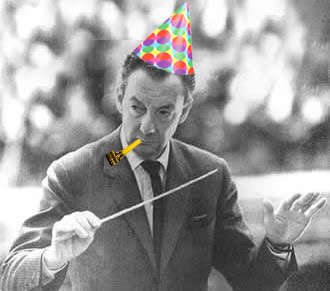
 English composer, conductor, violist and pianist Benjamin Britten was born on November 22, 1913 in Lowestoft, Suffolk. We are a day late but his birthday is certainly worth a mention, as our new production of his 1954 opera The Turn of the Scew is fast approaching.
In the coming weeks, I’ll be exploring Britten’s life and works on this blog. He was a child prodigy who would go on to change the course of opera in the 20th century. Thankfully, there are rich resources available online–courtesy of the Britten-Pears Foundation, one of our underwriters for Turn–and I intend to take full advantage of them!
As National Opera Week continues, we’re posing a question to readers of The MadOpera Blog: what’s your favorite opera? The conversation has already started on Facebook and Twitter (thanks to The Atlanta Opera), and now you can let us know in the comments section here.
I’d have to say that my favorite is Verdi’s
Otello–so many breathtaking moments, which is what it’s all about in my book–but it could also easily be
L’Orfeo (Monteverdi),
Le Nozze di Figaro (Mozart),
Parsifal (Wagner),
Salome (Strauss),
Nixon in China (John Adams), or
Orphee (Philip Glass).
It’s an impossible question, but your interest must be piqued now, so join the conversation in the spirit of Opera Week!
 Did you know this week is National Opera Week? Madisonians celebrated the power of opera with us at Carmen last weekend, and on Saturday the National Endowment for the Arts and Opera America officially kicked things off with the second annual Opera Honors:
In 2008, the National Endowment for the Arts (NEA) established the NEA Opera Honors to celebrate outstanding achievement and individual excellence. The awards are the highest honor the government bestows in opera, and this year they were presented on Saturday, November 14 at the Harman Center for the Arts in Washington, DC. OPERA America, the national nonprofit service organization, is the NEA partner in the Opera Honors program.
The 2009 awards were given in five categories: singer, composer, advocate, conductor and director. Combining power, flexibility and musicianship, Marilyn Horne expanded the repertoire for generations of mezzo-sopranos, and through the Marilyn Horne Foundation she has helped innumerable young singers as well as the future of the vocal recital. John Adams has rewoven the fabric of opera with works such as Nixon in China and Doctor Atomic. In his unique musical language, he confronts the moral complexities of our time, and dares audiences to do the same. Lotfi Mansouri was the innovative director of two major companies, the Canadian Opera and the San Francisco Opera, and revolutionized the art form through pioneering use of supertitles. Though he conducts throughout the world, Julius Rudel will be best remembered for taking a young company, the New York City Opera, and making it into a unique and international force. Since his first venture into opera—directing Susannah at the New York City Opera in 1958—Frank Corsaro has used his keen dramatic sensibilities to revivify the core repertoire and to create exciting productions of new and lesser-known works.